Parallax Basic Stamp
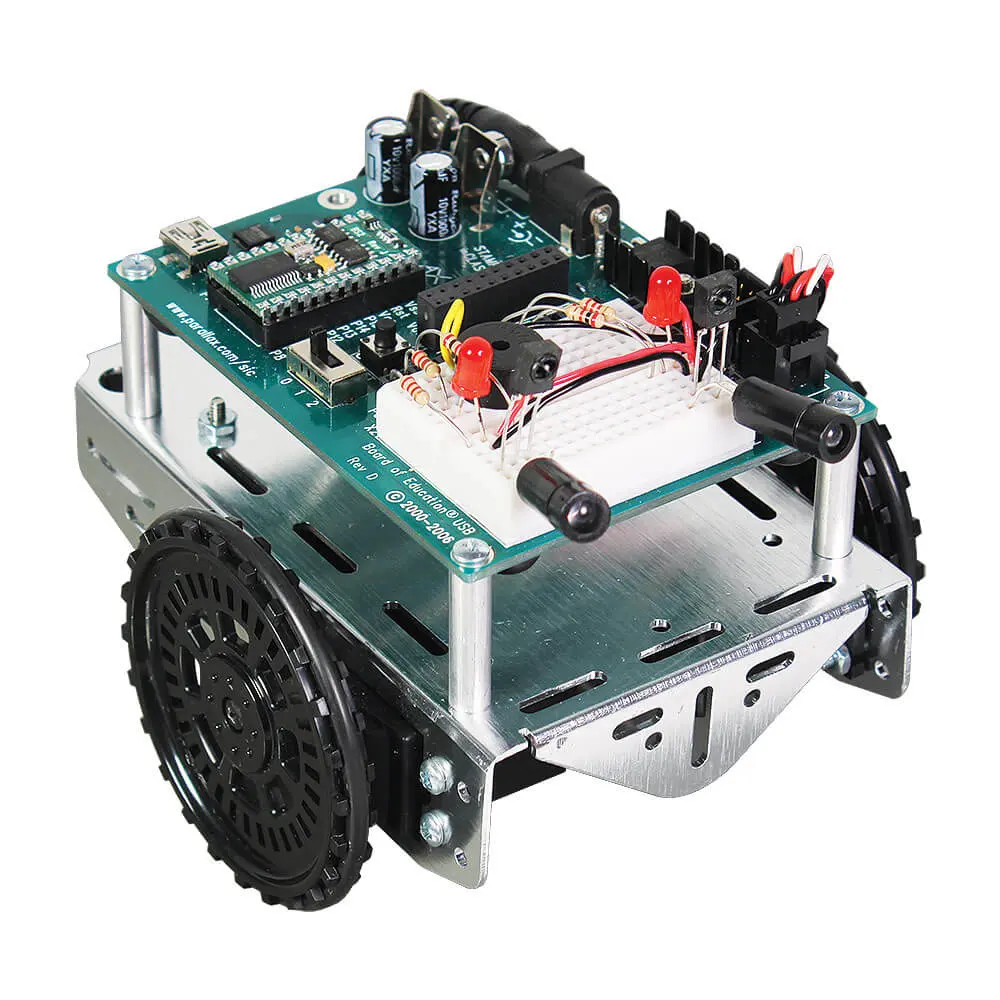
En 1997, Parallax produjo la Board of Education, un portaplacas de pruebas (breadboard) y placa de proyectos para el BASIC Stamp 2. Educadores de USA solicitaron rápidamente que se montara en un robot, y así se creó el Boe-Bot. Combinado con el libro de Andy Lindsay "Robotics with the Boe-Bot" y "What’s a Microcontroller", esta combinación de hardware y tutoriales se convirtió en un producto educativo popular.
Hoy en día, PBASIC sigue siendo uno de los lenguajes favoritos de muchos educadores y aulas, y gran parte de la investigación educativa inicial sobre la eficacia de los sistemas de computación física para enseñar programación utilizó el BASIC Stamp.
El Boe-Bot utiliza el lenguaje PBASIC. Los robots Boe-Bot se encuentran en escuelas secundarias y preparatorias, escuelas técnicas y universidades, clubes de robótica y en los hogares de aficionados.
Son excelentes compañeros para aprender o enseñar tecnología, mecatrónica y programas STEM. Este kit de robot puede utilizarse como una asignatura optativa en muchas escuelas.
El siguiente código de PBasic muestra cómo reproducir una canción utilizando el formato de música RTTL utilizado por teléfonos Nokia de principios de la década del 2000.
' What's a Microcontroller - MicroMusicWithRtttl.bs2
' Play Nokia RTTTL format ringtones using DATA.

'{$STAMP BS2}
'{$PBASIC 2.5}
DEBUG "Program Running!"

' -----[ I/O Definitions ]-------------------------------------------------

  SpeakerPin     PIN     9                   ' Piezospeaker connected to P9.

' -----[ Variables ]-------------------------------------------------------

  counter        VAR     Word                ' General purpose counter.
  char           VAR     Byte                ' Variable stores characters.
  index          VAR     Word                ' Index for pointing at data.

  noteLetter     VAR     Byte                ' Stores note character.
  noteFreq       VAR     Word                ' Stores note frequency.
  noteOctave     VAR     Word                ' Stores note octave.

  duration       VAR     Word                ' Stores note duration.
  tempo          VAR     Word                ' Stores tempo.

  default_d      VAR     Byte                ' Stores default duration.
  default_o      VAR     Byte                ' Stores default octave.
  default_b      VAR     Word                ' Stores default beats/min.

' -----[ EEPROM Data ]-----------------------------------------------------

  RTTTL_File     DATA    "Reveille:d=4,o=7,b=140:8g6,8c,16e,16c,8g6,8e,",
                         "8c,16e,16c,8g6,8e,8c,16e,16c,8a6,8c,e,8c,8g6,",
                         "8c,16e,16c,8g6,8e,8c,16e,16c,8g6,8e,8c,16e,",
                         "16c,8g6,8e,c,p,8e,8e,8e,8e,g,8e,8c,8e,8c,8e,8c,",
                         "e,8c,8e,8e,8e,8e,8e,g,8e,8c,8e,8c,8g6,8g6,c."

  Done           DATA    ",q,"

  Notes          DATA     "p",       "a",       "#",       "b",
                          "c",       "#",       "d",       "#",
                          "e",       "f",       "#",       "g",
                          "#"
  Octave8        DATA    Word 0,    Word 3520, Word 3729, Word 3951,
                         Word 4186, Word 4435, Word 4699, Word 4978,
                         Word 5274, Word 5588, Word 5920, Word 6272,
                         Word 6645

' -----[ Initialization ]--------------------------------------------------

  counter = 0                                ' Initialize counter.

  GOSUB FindEquals                           ' Find first '=' in file.
  GOSUB ProcessDuration                      ' Get default duration.
  GOSUB FindEquals                           ' Find next '='.
  GOSUB ProcessOctave                        ' Get default octave.
  GOSUB FindEquals                           ' Find last '='.
  GOSUB GetTempo                             ' Get default tempo.

' -----[ Program Code ]----------------------------------------------------

  DO UNTIL char = "q"                        ' Loop until 'q' in DATA.
    GOSUB ProcessDuration                    ' Get note duration.
    GOSUB ProcessNote                        ' Get index value of note.
    GOSUB CheckForDot                        ' If dot, 3/2 duration.
    GOSUB ProcessOctave                      ' Get octave.
    GOSUB PlayNote                           ' Get freq, play note, next.
  LOOP                                       ' End of main loop.

  END                                        ' End of program.

' -----[ Subroutine - Find Equals Character ]-----------------------------

  FindEquals:                                ' Go through characters in
                                             ' RTTTL file looking for
    DO                                       ' '='.  Increment counter
      READ RTTTL_File + counter, char        ' until '=' is found, then
      counter = counter + 1                  ' return.
    LOOP UNTIL char = "="

    RETURN

' -----[ Subroutine - Read Tempo from RTTTL Header ]----------------------
' Each keyboard character has a unique number called an ASCII value.
' The characters 0, 1, 2,...9 have ASCII values of 48, 49, 50,...57.
' You can always convert from the character representing a digit to
' to its value by subtracting 48 from the variable storing the digit.
' You can examine this by comparing DEBUG DEC 49 and DEBUG 49.

  GetTempo:                                  ' Parse RTTTL file for Tempo.
                                             ' Convert characters to
    default_b = 0                            ' digits by subtracting 48
    DO                                       ' from each character's ASCII
      READ RTTTL_File + counter, char        ' value.  Iteratively multiply
      IF char = ":" THEN                     ' each digit by 10 if there
        default_b = default_b / 10           ' is another digit, then add
        counter = counter + 1                ' the most recent digit to
        EXIT                                 ' one's column.
      ENDIF                                  ' For example, the string
        default_b = default_b + char - 48    ' "120" is (1 X 10 X 10)
        counter = counter + 1                ' + (2 X 10) + 0.  The '1'
        default_b = default_b * 10           ' is converted first, then
    LOOP UNTIL char = ":"                    ' multiplied by 10.  The '2'
                                             ' is then converted/added.
    RETURN                                   ' 0 is converted/added, done.

' -----[ Subroutine - Look up Octave ]------------------------------------

  ProcessOctave:                             ' Octave may or may not be
                                             ' included in a given note
    READ RTTTL_File + counter, char          ' because any note that is
    SELECT char                              ' played in the default
      CASE "5" TO "8"                        ' octave does not specify
        noteOctave = char - "0"              ' the octave.  If a char
        counter = counter + 1                ' from '5' to '8' then use
      CASE ELSE                              ' it, else use default_o.
        noteOctave = default_o               ' Characters are converted
    ENDSELECT                                ' to digits by subtracting
    IF default_o = 0 THEN                    ' '0', which is the same as
      default_o = noteOctave                 ' subtracting 48. The first
    ENDIF                                    ' time this subroutine is
                                             ' called, default_o is 0.
    RETURN                                   ' If 0, then set default_o.

' -----[ Subroutine - Find Index of Note ]--------------------------------

  ProcessNote:                               ' Set index value for lookup
                                             ' of note frequency based on
    READ RTTTL_File + counter, char          ' note character. If 'p',
    SELECT char                              ' index is 0.  If 'a' to 'g',
      CASE "p"                               ' read character values in
        index = 0                            ' DATA table and find match.
        counter = counter + 1                ' Record index value when
      CASE "a" TO "g"                        ' match is found.  If next
        FOR index = 1 TO 12                  ' char is a sharp (#), add
          READ Notes + index, noteLetter     ' 1 to the index value to
          IF noteLetter = char THEN EXIT     ' increase the index (and
        NEXT                                 ' frequency) by 1 notch.
        counter = counter + 1                ' As with other subroutines,
        READ RTTTL_File + counter, char      ' increment counter for each
        SELECT char                          ' character that is processed.
          CASE "#"
            index = index + 1
            counter = counter + 1
        ENDSELECT
    ENDSELECT

    RETURN

' -----[ Subroutine - Determine Note Duration ]---------------------------

  ProcessDuration:                           ' Check to see if characters
                                             ' form 1, 2, 4, 8, 16 or 32.
    READ RTTTL_File + counter, char          ' If yes, then convert from
                                             ' ASCII character to a value
    SELECT char                              ' by subtracting 48. In the
      CASE "1", "2", "3", "4", "8"           ' case of 16 or 32, multiply
        duration = char - 48                 ' by 10 and add the next
        counter = counter + 1                ' digit to the ones column.
        READ RTTTL_File + counter, char
        SELECT char
          CASE "6", "2"
            duration = duration * 10 + char - 48
            counter = counter + 1
        ENDSELECT
        CASE ELSE                            ' If no duration, use
        duration = default_d                 ' use default.
    ENDSELECT

    IF default_d <> 0 THEN                   ' If default_d not defined
      duration = 60000/default_b/duration*3  ' (if default_d = 0), then
    ELSE                                     ' set default_d = to the
      default_d = duration                   ' duration from the d=#.
    ENDIF

    RETURN

' -----[ Subroutine - Check For '.' Indicating 1.5 Duration ]-------------

  CheckForDot:                               ' Check for dot indicating
                                             ' multiply duration by 3/2.
    READ RTTTL_File + counter, char          ' If dot found, multiply by
    SELECT char                              ' 3/2 and increment counter,
      CASE "."                               ' else, do nothing and
        duration = duration * 3 / 2          ' return.
        counter = counter + 1
    ENDSELECT

    RETURN

' -----[ Subroutine - Find Comma and Play Note/Duration ]-----------------

  PlayNote:                                  ' Find last comma in the
                                             ' current note entry.  Then,
    READ RTTTL_File + counter, char          ' fetch the note frequency
    SELECT char                              ' from data, and play it, or
      CASE ","                               ' pause if frequency = 0.
        counter = counter + 1
        READ Octave8 + (index * 2), Word noteFreq
        noteOctave = 8 - noteOctave
        noteFreq = noteFreq / (DCD noteOctave)
        IF noteFreq = 0 THEN
           PAUSE duration
        ELSE
          FREQOUT SpeakerPin, duration, noteFreq
        ENDIF
    ENDSELECT

    RETURN
Un Basic Stamp en Chile puede ser adquirido en Rambal Robots.